We’re not going to let a few people stop it from happening,” AFL-CIO President Richard Trumka said. “Its time has come. Its time is long past due to be enacted. And we’ll do it."

The House passed Democrats’ wide-ranging overhaul of labor laws Tuesday, inching President Joe Biden closer to fulfilling a campaign promise and coinciding with Amazon workers’ ongoing push to unionize an Alabama warehouse.
But the Protecting the Right to Organize Act, which advanced mostly along party lines, is unlikely to win the 60 votes needed for passage in the narrowly controlled Senate. And already, some union leaders — who hold outsize sway in the Biden administration — are amping up pressure on Democrats to eliminate the filibuster so they can see one of their top priorities enacted.
“We’re not going to let a few people stop it from happening,” AFL-CIO President Richard Trumka said. “Its time has come. Its time is long past due to be enacted. And we’ll do it.”
“Everything is on the table so far as we’re concerned.”
Just five Republicans voted for the measure: co-sponsors Jeff Van Drew and Chris Smith (N.J.) and Brian Fitzpatrick (Pa.), along with Reps. John Katko (N.Y.) and Don Young (Alaska). One Democrat voted against it: Henry Cuellar (Texas), an aide said.
The bill’s advancement concludes several days of behind-the-scenes wrangling by Democratic leaders after a group of moderate members pushed for last-minute changes to the bill. By Monday night, top Democrats had agreed to include an amendment that would study the bill’s impact on gig workers, which the centrist bloc — led by Blue Dog Rep. Stephanie Murphy (D-Fla.), who voted against the bill last session — described as a win.
“There were some concerns about the flexibility aspect of the PRO Act, and if people could opt out if it didn’t suit their personal needs and circumstances,” Rep. Susan Wild (D-Pa.), who was among those backing the amendment, told POLITICO.
That change, Wild said, would help address some of the many concerns in the Senate, adding: “There’s a way to do it if we all really focus on it and we don’t insist on being purist.”
“If people need to do things to be able to support the bill, I’m all good with that,” Rep. Andy Levin (D-Mich.) said. “I don’t consider it much of a change.”
The legislation — which would make it easier for workers to join and form unions by empowering the National Labor Relations Board to levy fines and extending collective bargaining rights to independent contractors — is a real-time example of the thin line Biden must walk as he works to appease both the pro-union forces he has aligned himself with and the business groups who helped him win.
“People are realizing that unions are important,” House Education and Labor Chair Bobby Scott (D-Va.) told POLITICO. “They noticed this during the pandemic when there were unfair, unsafe working conditions.”
Businesses, fiercely opposed to the PRO Act, spent the days leading up to passage lobbying against it. More than 150 trade associations, including the influential Chamber of Commerce, sent a letter to lawmakers last week urging them to vote against the legislation, which they wrote “would cost millions of American jobs, threaten vital supply chains, and greatly diminish opportunities for entrepreneurs and small businesses.”
Employers "have deep concerns about the PRO Act’s intrusions on worker privacy and restrictions on workplace communication — among many other issues,” Jay Timmons, president and CEO of the National Association of Manufacturers, said. “It will make it harder for manufacturers to thrive and more difficult to foster positive, inclusive workplace cultures.”
Republicans echo many of the same concerns, fretting that the bill — which Rep. Virginia Foxx, the top Republican on the House Education and Labor Committee, has dubbed the Pro Union Bosses Act — will cost employers and eliminate jobs. They also take issue with the fact the bill would preempt state right-to-work laws, which guarantee no worker can be required to join a union or pay dues as a condition of employment.
It's "a left-wing wish list of union boss priorities which undermines the rights of workers by forcing them to pay into a union system, whether or not they want to be represented by a union," Foxx said.
The PRO Act "is yet another attack on states’ rights," Rep. Mariannette Miller-Meeks (R-Iowa) said on the floor. Iowa is a right-to-work state.
Unions have thrown their weight behind the legislation, which leaders have described repeatedly as one of their top priorities for a Biden administration. Indeed, the executive board of the AFL-CIO — the nation’s largest federation of unions — plans to meet Wednesday to discuss its position on eliminating the filibuster, likely the only path forward for seeing the PRO Act enacted.
“I assume that [Senate passage] requires getting rid of the filibuster for sure, or finding some way around it,” Levin said.
Senate HELP Chair Patty Murray (D-Wash.) told POLITICO that she plans “to fight hard to make sure we honor the essential workers that have kept us going during this pandemic by getting the PRO Act across the finish line.”
“As workers continue to bear the brunt of this pandemic, ensuring they can stand together and fight for better pay, quality health care, a safer workplace and a secure retirement has never been more important,” she said.
Prior to passage, lawmakers adopted a package of Democratic amendments containing the Murphy amendment, among others. They rejected a set of Republican amendments.
Passage coincides with Amazon workers’ ongoing push to form a union at one of the retail giant’s Alabama facilities. Biden was notably mute on the issue until February, when he released a video expressing support for organized labor. Despite declining to mention Amazon by name, it was nonetheless hailed as the most pro-union statement from a sitting U.S. president.
The House first advanced the bill in February 2020 after it languished for months amid many of the same concerns floated this session: worries from moderate Democrats that it was anti-business and relentless bashing from groups including the Chamber of Commerce, which labeled it "a litany of almost every failed idea from the past 30 years of labor policy." But it was never taken up by then-Senate Majority Leader Mitch McConnell.
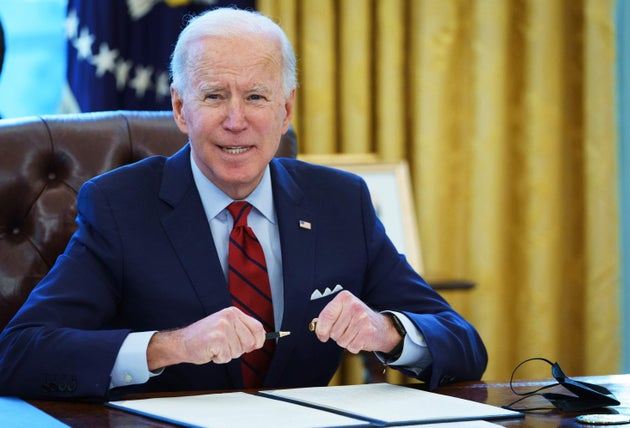
Biden pledged on the campaign trail that he would see the legislation enacted, and reiterated his support for the legislation Monday with a full-throated Statement of Administration Policy encouraging House passage.
“We should all remember that the National Labor Relations Act didn’t just say that we shouldn’t hamstring unions or merely tolerate them. It said that we should encourage unions,” Biden said in a statement Tuesday. “The PRO Act would take critical steps to help restore this intent.”
“We have a champion who more than any of his recent predecessors understands that labor isn’t just another constituency group that exists only during campaign cycles, and his rhetoric on the campaign trail has been carried into the Oval Office,” Trumka said. “This is a president who jumps at the chance to tell a roomful of CEOs that he’s a union guy. He released the most pro-union statement of any president since FDR, and just yesterday, he chose to double down.”
“To borrow a lightly tweaked quote from Joe Biden, this is a big freaking deal.”
Unions have fought to enact labor law reform since 1947, when a Republican Congress passed the Taft-Hartley Act and, in doing so, made changes to the National Labor Relations Act that labor advocates consider anti-union. But the efforts have yet to be successful.
Even under former President Barack Obama, a package containing many provisions similar to the PRO Act — the Employee Free Choice Act — stalled in Congress as his administration focused its efforts elsewhere.