Friday, April 16, 2021

Make Me Smart with Kai and Molly Podcast

The News Fix

Amazon’s workforce has begun to agitate. The nation’s second-largest employer managed to quash a union drive at its fulfillment center in Bessemer, Alabama, this week, but the campaign has lit a spark among Amazon’s 1 million workers in the United States. The group leading the charge in Bessemer, the Retail, Wholesale and Department Store Union, has heard from hundreds of Amazon workers in other parts of the country. And the Teamsters have been working to organize the company’s delivery drivers through an initiative they call the Amazon Project. 

Some labor organizers say the strategy at Amazon could shift in the near term to less formal actions. Under today’s laws, workers typically have to hold and win elections site by site — a huge undertaking at an employer as large and sprawling as Amazon. But informal walkouts and demonstrations could be held companywide, organizers say. A Teamsters leader in Iowa told the New York Times, “We’re focused on building a new type of labor movement where we don’t rely on the election process to raise standards.”

Organizing the new but growing e-commerce workforce could take a while. A union campaign at the Bethlehem Steel mill on Baltimore’s Sparrows Point peninsula took 50 years and met with fierce opposition before the vote finally passed in 1941 as the U.S. ramped up wartime manufacturing. By the 1950s, work at the plant “had become safer and far better-paid,” Alec MacGillis wrote in The New Yorker this week. (Bethlehem Steel’s mill shut down in 2012, and today the site is home to an Amazon fulfillment center — with a nonunionized workforce.) 

Thursday, March 18, 2021

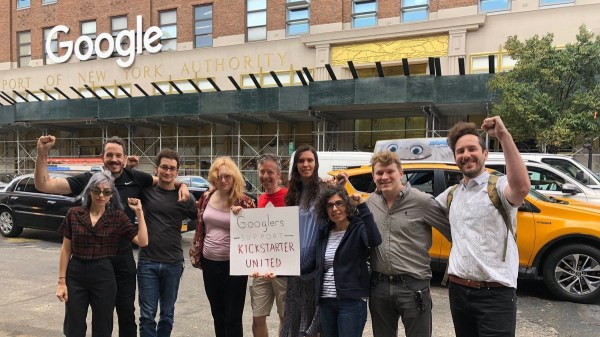
Kickstarter workers voted to unionize. It wasn’t about working conditions.


Kickstarter workers voted to unionize. It wasn’t about working conditions.

Seeking a say in corporate decision-making, tech workers are looking for ways to wield influence.

Earlier this week, there was a surprising development in the tech industry: Employees of Kickstarter, a tech company, formed a union. This, of course, is happening while a lot of other tech employees are agitating at work. Some Google contract workers in Pittsburgh voted to form a union, Amazon warehouse workers have organized to protect their co-workers and gig workers have gone on strike.

But tech workers want more from their employers than the typical things that unions provide — decent hours, good wages and overtime pay. Tech workers might want to form or join unions, but they also want to disrupt them. I dig into this in “Quality Assurance,” the segment where I take a deeper look at a big tech story. I spoke with Megan McCarty Carino, who covers workplace issues at Marketplace, and I asked her my favorite question: On a scale of 1-10, how big a deal is this Kickstarter union? The following is an edited transcript of our conversation.

Meghan McCarty Carino: I would say it’s maybe like an eight. It’s really something very interesting to watch, because unlike what we talked about with the Google contractors unionizing, I think that was much more about the issues that we’re used to hearing unions deal with — these were contractors, they wanted to have equal pay and equal benefits compared to the full-time workers that they worked alongside at Google.

Wood: So you’re saying some of those things — these fuzzier, I guess, or culture issues — they are a part of this union, this contract. What do you think this means for the rest of the tech industry? How representative is Kickstarter when it comes to trying to replicate this success across the industry?

McCarty Carino: I think the representativeness of Kickstarter as a tech company is an interesting thing to look at. Of course, Kickstarter is in Brooklyn, it’s not in Silicon Valley. A couple years ago, it declared itself a public benefit corporation. However, I do think that the concerns that the union is going to be grappling with are pretty similar to some of the concerns that tech workers have voiced at other tech companies. To see the degree to which collective bargaining is able to really bring these issues to the table and bring a successful outcome that the workers feel satisfied with, I think other workers will be watching that.

Wood: So you’re saying it could go either way? They might look at it and say, “This looks great,” but the employees might also look at it and say, “That looks limiting”?

McCarty Carino: It could be a case where it looks like having a formal union and having a formal process to bring issues to the table with the employer is really useful, especially as we’re seeing cases at Google and cases at Amazon — employees being dismissed who have been linked to worker activism. Having the heft of a union behind you can sometimes help to clarify those dismissal processes and do conflict resolution in a way that feels more satisfying to the workers. However, there’s a lot of question marks still to be worked out about how a union is going to really deal with the issues that I think these specific workers want to deal with.